
If you’re thinking about getting Botox in Brooklyn, the first thing you probably want to know is what it’s going to cost. It’s a smart question — and a surprisingly tricky one to get a straight answer to, because Botox isn’t priced like a flat service. It’s typically priced per unit, and the number of units you need depends entirely on what you’re treating. That’s exactly why two people can walk out of the same office having paid very different amounts.
This guide clears it all up. We’ll cover how much Botox costs per unit in Brooklyn, how many units you actually need for each area, how to estimate your total cost, what makes the price go up or down, and how to save — plus the one thing you should never do when choosing where to get it. By the end, you’ll know exactly what to expect before you ever sit in the chair.
Let’s start with the number you came for.
Table of Contents
ToggleHow Much Does Botox Cost in Brooklyn?
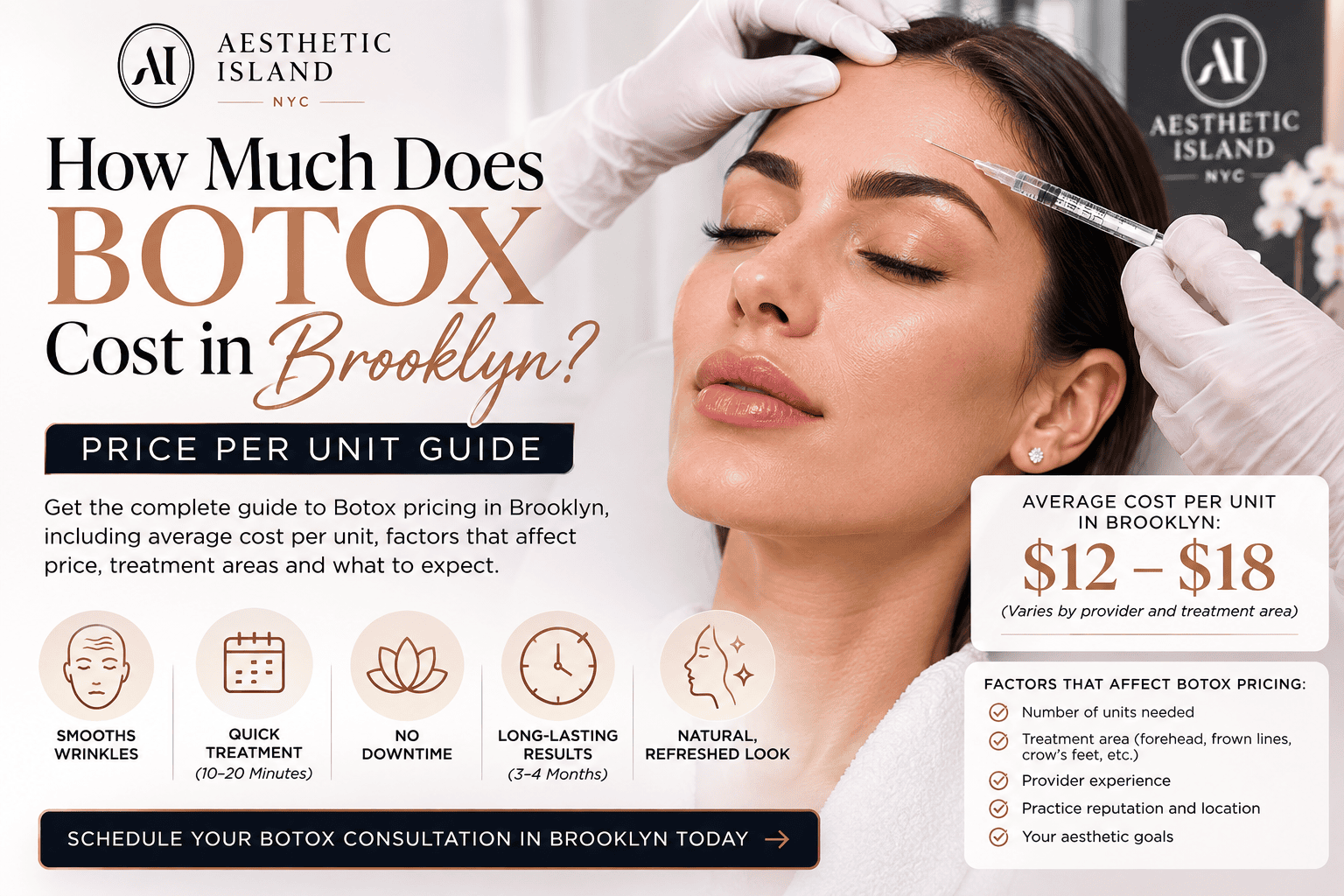
In Brooklyn, Botox typically costs around $12 to $18 per unit, with the exact rate depending on the provider, their experience, and the practice. Since most treatments use somewhere between 20 and 60 units, a typical Botox appointment in Brooklyn often lands anywhere from roughly $250 to $900, depending on how many areas you’re treating.
A few things to keep in mind right away:
- This is a general market range, not a fixed price — your actual cost depends on your specific treatment plan.
- Some practices price Botox per area instead of per unit (more on both models below).
- The only way to know your exact cost is a consultation, where a provider assesses your goals and tells you how many units you’ll need.
Now let’s break down what actually determines your number — starting with how Botox pricing works.
How Botox Pricing Works: Per Unit vs. Per Area
There are two common ways med spas price Botox, and knowing the difference protects you from confusion (and from overpaying).
Per-unit pricing. This is the most common and transparent model. You’re charged a set price for each unit of Botox used — say, $14 per unit — and you pay for exactly the number of units your treatment requires. The big advantage is transparency: you only pay for what you actually get, and you can verify the math. The potential downside is that a less scrupulous injector could pad the unit count, which is why choosing a trustworthy provider matters (more on that later).
Per-area (or per-zone) pricing. Here, you’re charged a flat rate to treat a specific area — for example, a set price for “frown lines” regardless of how many units it takes. This can feel simpler, but it can work against you if your area needs fewer units than average (you might overpay) or in your favor if it needs more. It’s also less transparent, since you don’t always know how much product you’re actually getting.
Most reputable Brooklyn practices use per-unit pricing because it’s the fairest and clearest. When you’re comparing prices, always ask which model a practice uses — comparing a per-unit price to a per-area price is apples to oranges.
What Is a “Unit” of Botox?
Since pricing hinges on units, it helps to understand what one is. A “unit” is simply the standardized measure of Botox’s active ingredient — the dose. Think of it like measuring a medication: your provider determines how many units are needed to relax a given muscle enough to smooth the lines it creates. Stronger muscles and larger areas need more units; delicate areas need fewer.
This is why “how much does Botox cost” doesn’t have a one-size-fits-all answer. The cost is really a function of how many units your particular muscles and goals require — which brings us to the most useful part of this guide.
How Many Units of Botox Do You Need? (By Area)
Here’s a general guide to how many units each common treatment area typically requires. These are typical ranges — your provider will determine your exact dosing based on your anatomy, muscle strength, and goals.
- Forehead lines (horizontal lines): ~10–20 units
- Frown lines / glabella (the “11s” between your brows): ~15–25 units
- Crow’s feet (around the eyes, both sides): ~12–24 units
- Bunny lines (on the nose): ~5–10 units
- Lip flip (subtle upper-lip enhancement): ~4–8 units
- Chin (dimpling/”orange peel” texture): ~4–10 units
- Gummy smile: ~2–6 units
- Masseter (jaw slimming / TMJ / teeth grinding): ~20–50+ units total (a larger, stronger muscle)
- Neck bands (platysmal bands / “Nefertiti lift”): ~25–60 units (a larger area)
Many first-time patients start with the “upper-face three” — forehead, frown lines, and crow’s feet — which together often total around 40 to 64 units. Others come in for a single area, like just the frown lines (often ~20 units) or a quick lip flip.
Estimating Your Total Botox Cost
Now you can do the simple math. Multiply the units you’re likely to need by the per-unit price. For example, at a rate of $14 per unit:
- Frown lines only (~20 units): roughly $280
- Forehead + frown lines (~30–40 units): roughly $420–$560
- Full upper face — forehead, frown lines, crow’s feet (~40–64 units): roughly $560–$900
- Lip flip (~5 units): roughly $70
- Masseter / jaw (~40 units): roughly $560
Remember, these are estimates to help you plan — your provider will give you an exact figure once they’ve assessed how many units you actually need. But this framework lets you walk into a consultation with realistic expectations instead of sticker shock.
What Affects the Cost of Botox in Brooklyn?
Several factors move your final price up or down:
1. The number of units you need. The biggest driver, as covered above. More areas and stronger muscles mean more units, which means a higher total.
2. The provider’s expertise. Highly experienced, credentialed injectors — nurse practitioners, PAs, and physicians with deep training — often charge more per unit than a bargain provider. As you’ll see below, that’s usually money well spent.
3. Per-unit vs. per-area pricing. As discussed, the pricing model changes how your total is calculated.
4. Location within the city. Brooklyn is generally somewhat more affordable than Manhattan, where per-unit prices can run higher. Neighborhood and practice overhead play a role too.
5. The product used. This guide is about Botox specifically, but practices may also offer other neurotoxins (Dysport, Xeomin, Jeuveau) that are dosed and priced differently per unit. If you’re comparing prices, make sure you’re comparing the same product.
6. Specials, packages, and loyalty programs. First-time offers, memberships, and manufacturer rewards can meaningfully lower your effective cost (more below).
Botox vs. Dysport, Xeomin, and Jeuveau: A Note on Pricing
You may see other “tox” brands advertised at what looks like a cheaper per-unit price — but this can be misleading. Different neurotoxins use different dosing scales. Dysport, for example, is typically dosed in higher unit numbers than Botox to achieve a comparable effect, so a lower per-unit price doesn’t necessarily mean a lower total cost. When comparing brands, look at the total treatment cost and the results, not just the per-unit sticker price. Your provider can explain which product suits your goals and how the pricing compares fairly.
Why You Should Never Choose Botox on Price Alone
Here’s the most important cost advice in this guide: with Botox, the cheapest option can be the most expensive mistake.
Botox is a prescription medical treatment, and your results — natural or frozen, balanced or uneven, subtle or overdone — depend almost entirely on the skill of your injector. An experienced provider understands facial anatomy, dosing, and technique well enough to give you a refreshed, natural look. An inexperienced or bargain injector can leave you with a heavy brow, an asymmetric result, or the dreaded “overdone” look — problems that cost time, money, and stress to correct (and Botox can’t be dissolved the way filler can; you have to wait for it to wear off).
There’s also a safety dimension. Suspiciously low prices can sometimes signal diluted product, counterfeit product, or an unlicensed injector — all serious risks. Real Botox performed by a qualified, licensed medical professional is what you want, and it’s worth paying a fair price for.
The right way to think about it: you’re not just buying units of product, you’re buying the expertise that makes those units look good on your face. That’s where the real value is.
How to Save on Botox (Without Cutting Corners)
You can absolutely be smart about cost without gambling on a bargain injector. Here’s how:
First-time specials. Many practices offer new-patient promotions or introductory per-unit rates. Ask what’s available for your first visit.
Manufacturer rewards programs. Botox is made by Allergan, whose Allē rewards program lets you earn points on Botox (and other treatments) that convert into savings on future appointments. Enrolling is free and adds up over time.
Memberships and packages. Some med spas offer memberships or bundled pricing that lower your effective per-unit cost if you’re a regular.
Financing. For larger treatment plans, financing options let you spread the cost over time. Ask what plans your provider offers.
Combine your visits. If you’re also considering dermal fillers or other treatments, doing them together can sometimes unlock package value — and if you’re weighing filler costs too, our guide to lip filler cost in Brooklyn breaks that down the same way.
The goal isn’t the lowest price — it’s the best value: an experienced injector at a fair rate, with smart use of specials and rewards.
Does Insurance Cover Botox?
For cosmetic purposes — smoothing wrinkles and fine lines — no. Cosmetic Botox is elective and paid out of pocket. However, Botox is also FDA-approved for certain medical conditions, such as chronic migraines, excessive sweating (hyperhidrosis), and TMJ/jaw-related issues, and in those cases insurance may provide coverage. If you’re seeking Botox for a medical reason, check with your provider and insurer. For the aesthetic treatments most people are asking about, plan on it being out of pocket — with the savings strategies above to help.
How Long Does Botox Last? (And Why It Matters for Cost)
Botox typically lasts about three to four months before the muscle activity gradually returns and your lines begin to reappear. That’s worth factoring into your budget, since maintaining your results means repeat treatments a few times a year. The upside: many patients find that with consistent treatment over time, they need slightly less product to maintain their results, as the treated muscles become less active. Thinking of Botox as an ongoing part of your routine — rather than a one-time purchase — helps you budget realistically and take advantage of rewards programs that reward repeat visits.
Botox Cost at Aesthetic Island in Brooklyn
At Aesthetic Island in Brooklyn, we believe in honest, transparent Botox pricing — no games, no padded unit counts, no pressure. Your Botox treatment is performed by our lead aesthetic provider, Eva Israilova, NP, in a practice featured in USA Today, OK! Magazine, Haute Living, and Haute Beauty. At your consultation, we’ll assess your facial anatomy and goals, tell you exactly how many units you’ll need and what it will cost, and walk you through any specials, rewards, and financing options — so you can make an informed decision with total confidence.
If you’re ready to find out what Botox would cost for your specific goals, the best next step is simple. Book your consultation today or call (917) 809-0570 for a personalized quote.
Frequently Asked Questions
How much does Botox cost per unit in Brooklyn?
In Brooklyn, Botox typically costs around $12 to $18 per unit, depending on the provider and their experience. Since most treatments use 20 to 60 units, a typical appointment often runs from about $250 to $900. Your exact price is confirmed at consultation.
How many units of Botox will I need?
It depends on the areas treated. Frown lines often take ~15–25 units, forehead lines ~10–20, and crow’s feet ~12–24. A full upper-face treatment commonly totals around 40–64 units.
Is per-unit or per-area Botox pricing better?
Per-unit pricing is generally more transparent — you pay only for the product you receive and can verify the count. Per-area pricing can be simpler but less clear. Always ask which model a practice uses.
Why is some Botox so cheap?
Suspiciously low prices can signal an inexperienced injector, diluted or counterfeit product, or padded unit counts. Botox results and safety depend on your injector’s skill, so it’s not a place to bargain-hunt.
Does insurance cover Botox?
Not for cosmetic use, which is paid out of pocket. Insurance may cover Botox for certain medical conditions like chronic migraines, excessive sweating, or TMJ. Check with your provider and insurer.
How can I save on Botox?
Look for first-time specials, enroll in Allergan’s Allē rewards program, ask about memberships and packages, and consider financing for larger plans — all without resorting to a bargain injector.
How long does Botox last?
Typically about three to four months, after which repeat treatments maintain your results. Factor this into your budget, since Botox is an ongoing rather than one-time treatment.

