
Hair loss affects millions of men and women every year. For some, it begins gradually with a widening part or subtle thinning around the temples. For others, hair loss can be more aggressive, leading to noticeable scalp visibility, receding hairlines, or significant reductions in hair density.
Regardless of the cause, hair loss often impacts confidence, self-image, and overall quality of life.
Traditional treatments such as topical medications, oral prescriptions, and hair transplants have helped many patients, but advances in regenerative medicine are creating entirely new possibilities for hair restoration. One of the most exciting developments is exosome therapy.
Exosomes have quickly become one of the most talked-about innovations in regenerative aesthetics and hair restoration. By harnessing powerful biological signaling molecules that support cellular communication and tissue repair, exosomes offer a cutting-edge approach to stimulating hair growth naturally.
At Aesthetic Island in Brooklyn, NY, more patients are exploring regenerative treatments that work with the body’s own healing mechanisms rather than relying solely on medications or surgery.
In this guide, we’ll explain what exosomes are, how exosome therapy works for hair loss, who may benefit from treatment, and why many experts consider exosomes one of the most promising advancements in modern hair restoration.
Table of Contents
ToggleUnderstanding Hair Loss
Before discussing exosomes, it’s important to understand why hair loss occurs.
Hair growth is a complex biological process involving hair follicles, blood supply, hormones, genetics, and cellular communication.
Hair naturally cycles through three phases:
Anagen Phase (Growth Phase)
This is the active growth period of the hair follicle.
Healthy follicles remain in this phase for several years.
Catagen Phase (Transition Phase)
Hair growth slows as follicles prepare to enter a resting stage.
Telogen Phase (Resting Phase)
The hair eventually sheds and the follicle begins preparing for a new growth cycle.
Hair loss occurs when this cycle becomes disrupted or follicles become damaged.
Common Causes of Hair Loss
Androgenetic Alopecia
Also known as male pattern baldness or female pattern hair loss, this is the most common cause of hair thinning.
It is influenced by:
- Genetics
- Hormones
- Age
Stress
Physical and emotional stress can trigger excessive shedding.
Hormonal Changes
Hair loss may occur due to:
- Pregnancy
- Menopause
- Thyroid disorders
- Hormonal imbalances
Nutritional Deficiencies
Deficiencies in iron, protein, vitamin D, and other nutrients can contribute to thinning hair.
Aging
Hair follicles naturally become less active with age.
What Are Exosomes?
Exosomes are microscopic extracellular vesicles naturally released by cells.
Their primary role is communication.
These tiny structures transport important biological information between cells, helping coordinate healing, regeneration, and tissue repair.
Exosomes contain:
- Growth factors
- Proteins
- Cytokines
- Messenger RNA (mRNA)
- MicroRNA
- Signaling molecules
Think of exosomes as tiny biological messengers that tell cells how to behave.
They play a critical role in maintaining healthy tissue function throughout the body.
Why Exosomes Are Important for Hair Growth
Healthy hair follicles depend on constant communication between cells.
As hair follicles age or become damaged, these communication pathways can weaken.
Exosomes help restore cellular communication by delivering regenerative signals directly to follicular tissues.
These signals may encourage:
- Follicle activation
- Improved blood flow
- Reduced inflammation
- Enhanced tissue repair
- Stronger hair growth
This regenerative effect is what makes exosomes so promising for hair restoration.
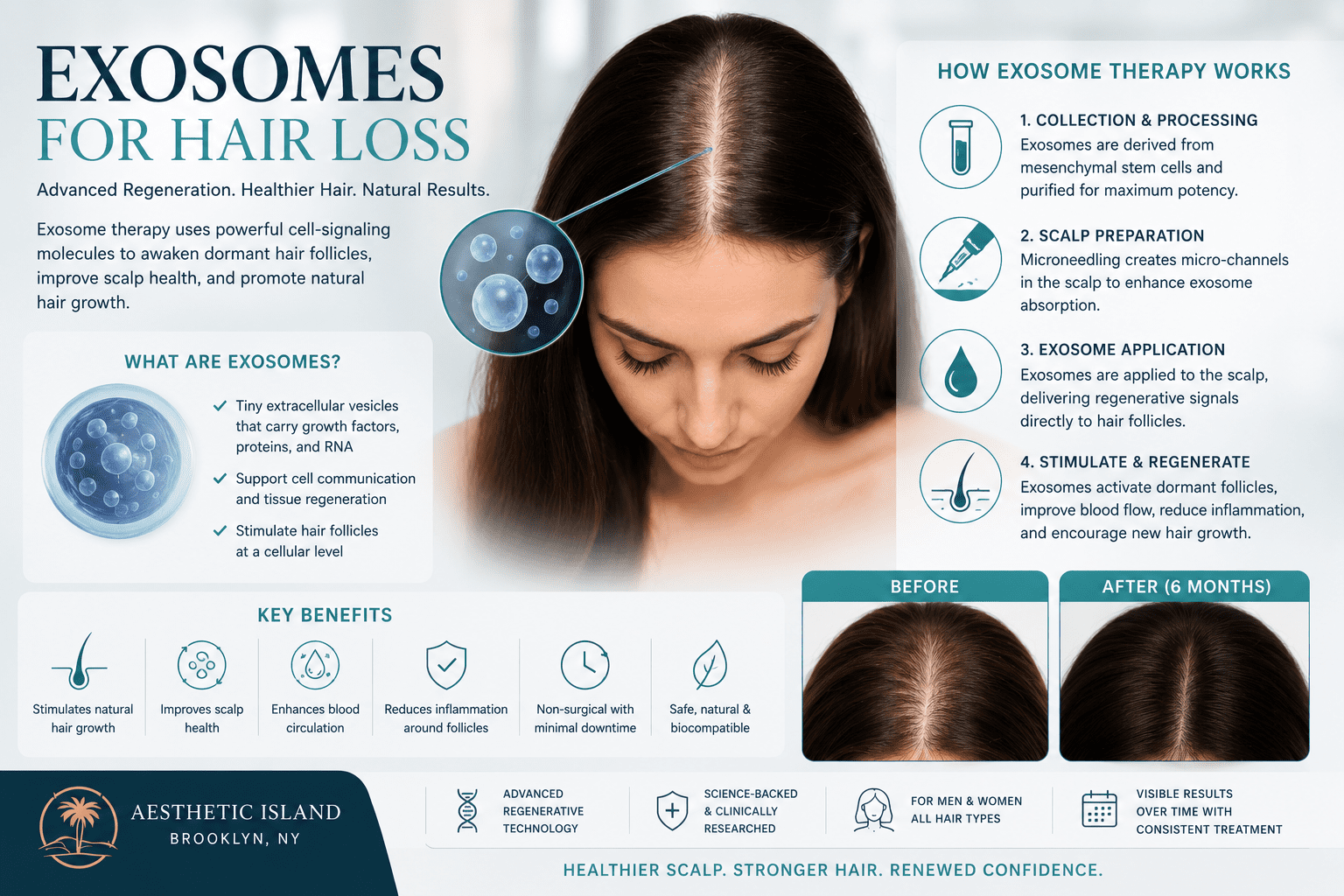
How Exosome Therapy Works for Hair Loss
Exosome therapy introduces concentrated regenerative signaling molecules into areas affected by hair thinning.
The treatment is designed to stimulate follicular activity and create a healthier environment for hair growth.
Cellular Activation
Exosomes communicate directly with follicle cells.
They deliver biological instructions that may encourage dormant follicles to become more active.
Growth Factor Delivery
Exosomes contain numerous growth factors associated with tissue repair and regeneration.
These growth factors support:
- Cellular repair
- Hair follicle health
- Improved follicular function
Reduced Inflammation
Inflammation can contribute to follicle damage and hair loss.
Exosomes help regulate inflammatory responses that may interfere with healthy growth.
Enhanced Blood Supply
Healthy follicles require oxygen and nutrients.
Exosome therapy may help improve the environment surrounding hair follicles by supporting circulation and tissue health.
What Happens During Exosome Hair Restoration Treatment?
The procedure is relatively straightforward and minimally invasive.
Consultation
Your provider evaluates:
- Hair loss pattern
- Medical history
- Hair density
- Treatment goals
A customized treatment plan is then developed.
Scalp Preparation
The scalp is cleansed and prepared.
Microneedling or Delivery Method
Many providers use microneedling to create microscopic channels within the scalp.
These channels help improve exosome penetration.
Exosome Application
The exosome solution is applied to targeted areas of hair thinning.
The regenerative factors are then absorbed into the scalp tissue.
Recovery
Most patients return to normal activities shortly after treatment.
Exosomes vs PRP for Hair Loss
One of the most common comparisons is between exosome therapy and PRP.
PRP (Platelet-Rich Plasma)
PRP is derived from the patient’s own blood.
It contains:
- Platelets
- Growth factors
- Healing proteins
PRP has been used successfully for hair restoration for many years.
Exosomes
Exosomes provide:
- Concentrated signaling molecules
- Advanced cellular communication
- Regenerative proteins
- Growth factors
Some experts believe exosomes may deliver stronger regenerative signaling than PRP alone.
Many patients who have already tried PRP are interested in exosomes as the next generation of regenerative hair restoration.
Exosomes vs Hair Transplants
Hair transplants remain one of the most effective solutions for advanced hair loss.
However, exosome therapy serves a different purpose.
Hair Transplants
- Surgical procedure
- Relocates follicles
- Creates permanent hair growth in transplanted areas
Exosome Therapy
- Non-surgical
- Supports existing follicles
- Encourages natural growth
- Improves scalp health
In many cases, exosomes may be used before or after hair transplant surgery to support overall results.
Benefits of Exosomes for Hair Loss
Non-Surgical Treatment
No incisions or surgical recovery are required.
Minimal Downtime
Most patients return to normal activities immediately.
Supports Natural Hair Growth
The treatment works with existing follicles rather than replacing them.
Regenerative Approach
Exosomes address underlying follicular health rather than simply masking symptoms.
Suitable for Men and Women
Both genders may benefit from treatment.
May Improve Hair Thickness
Many patients notice improved density and hair quality over time.
Who Is a Good Candidate for Exosome Therapy?
Exosome therapy may be beneficial for individuals experiencing:
Early Hair Thinning
Patients with mild to moderate thinning often respond best.
Male Pattern Baldness
Exosomes may help support follicle health during early stages of androgenetic alopecia.
Female Pattern Hair Loss
Women experiencing diffuse thinning may benefit from regenerative treatment.
Postpartum Hair Loss
Exosomes may help support recovery after temporary shedding.
Hair Weakening Due to Aging
Many patients use exosomes to improve overall hair quality and density.
Who May Not Be an Ideal Candidate?
Exosome therapy is most effective when functioning hair follicles remain present.
Patients with:
- Extensive baldness
- Long-standing follicle destruction
- Certain medical conditions
may require alternative treatment approaches.
A consultation is essential to determine candidacy.
How Soon Will You See Results?
Hair restoration requires patience.
Most patients do not see immediate growth because hair follicles need time to respond.
Typical timelines include:
First Month
Scalp health improvements begin.
Two to Three Months
Some patients notice reduced shedding.
Three to Six Months
Visible improvements in density and thickness may develop.
Six to Twelve Months
Continued enhancement often occurs as follicles cycle through growth phases.
How Long Do Results Last?
Results vary based on:
- Age
- Genetics
- Hormones
- Overall health
- Severity of hair loss
Many patients undergo maintenance treatments periodically to support long-term results.
Can Exosomes Be Combined with Other Hair Loss Treatments?
Yes.
Many providers combine exosomes with:
PRP
Enhanced regenerative stimulation.
Microneedling
Improves exosome absorption and scalp regeneration.
Prescription Hair Loss Medications
Supports multiple pathways involved in hair growth.
Nutritional Support
Addressing deficiencies may further improve outcomes.
A multi-modal approach often delivers the best results.
Why Exosome Therapy Is Becoming So Popular
Patients increasingly seek treatments that:
- Look natural
- Require minimal downtime
- Support long-term health
- Avoid surgery
Exosome therapy aligns perfectly with these goals.
The treatment represents a shift toward regenerative medicine, where the focus is on helping the body repair and rejuvenate itself.
Rather than simply covering up problems, exosomes work to improve the biological environment surrounding hair follicles.
Why Brooklyn Patients Are Exploring Exosomes for Hair Loss
Brooklyn patients are often early adopters of advanced aesthetic technologies.
Many individuals prefer innovative treatments that combine science and natural healing mechanisms.
Exosomes appeal to patients who want:
- Non-surgical solutions
- Natural-looking results
- Advanced regenerative medicine
- Improved hair health
This growing demand has helped make exosome therapy one of the most requested regenerative treatments today.
Why Choose Aesthetic Island for Hair Restoration Treatments?
At Aesthetic Island, we focus on advanced regenerative treatments designed to support natural beauty and long-term results.
Every hair restoration consultation includes:
- Detailed scalp evaluation
- Hair loss assessment
- Customized treatment planning
- Personalized recommendations
Our goal is to help patients achieve healthier, fuller-looking hair using science-backed treatments tailored to their individual needs.
Final Thoughts
Exosome therapy represents one of the most exciting developments in modern hair restoration. By improving cellular communication and delivering powerful regenerative signals directly to hair follicles, exosomes offer a promising non-surgical solution for men and women experiencing hair loss.
While results vary from patient to patient, exosomes may help support thicker, healthier hair by improving follicle function and scalp health at a cellular level.
For individuals seeking an advanced regenerative approach to hair restoration, exosome therapy may provide an innovative alternative to traditional treatments.
If you’re concerned about thinning hair or early hair loss, schedule a consultation at Aesthetic Island in Brooklyn to learn whether exosome therapy may be right for you and discover how regenerative medicine is changing the future of hair restoration.
If you are searching for the best med spa in Brooklyn, schedule your Appointment today and take the first step toward a more confident you.

