
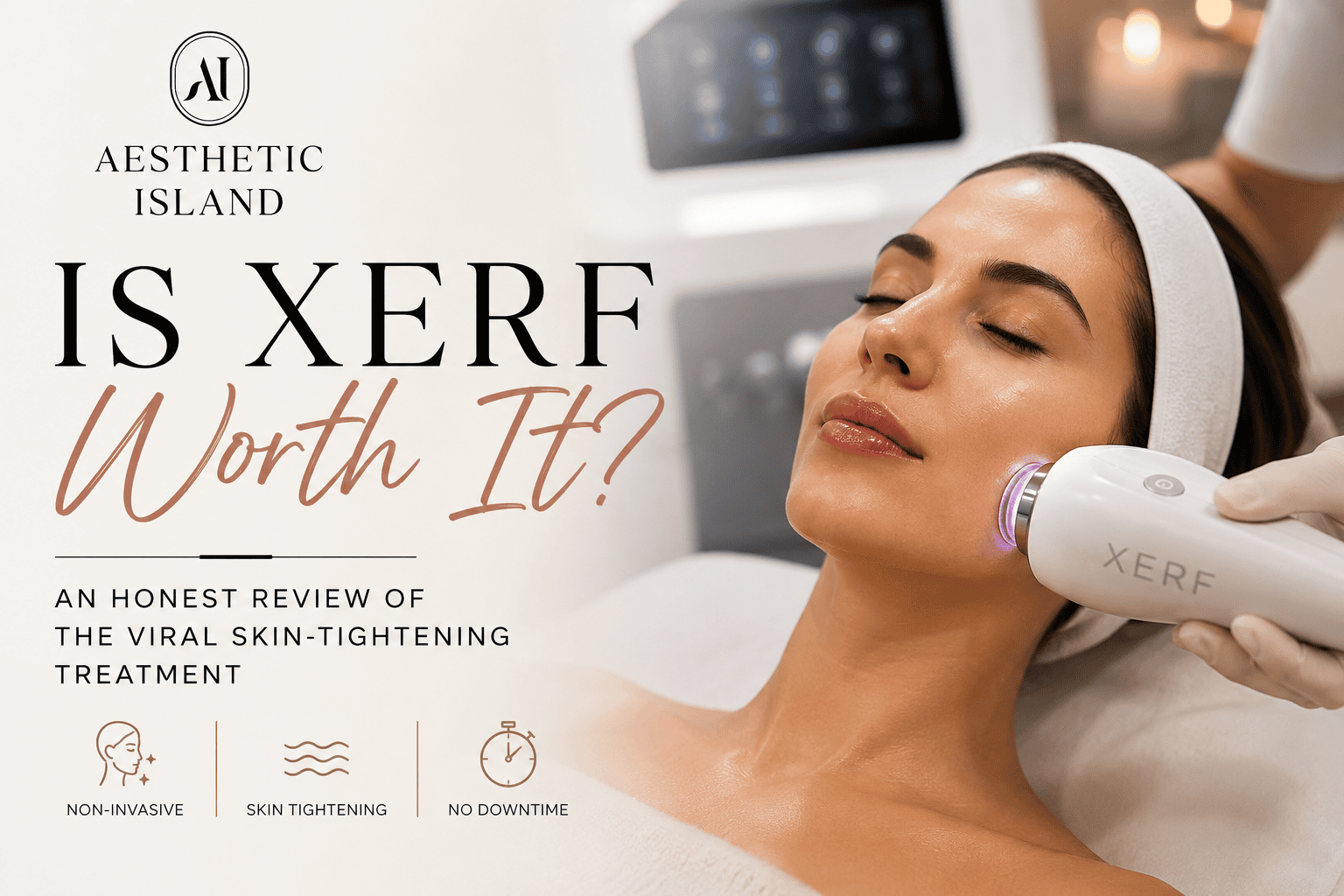
Every few months, a new skin-tightening treatment goes viral. Usually the hype outruns the science, and by the time you’ve booked a consultation, the “miracle” turns out to be a maintenance treatment with a good PR team. So when XERF started flooding beauty feeds — racking up TikToks, magazine write-ups, and a now-famous mention from Kim Kardashian — the honest question wasn’t “how fast can I book it?” It was “is XERF actually worth it, or is this just the next shiny device?“
This is that honest review. At Aesthetic Island in Brooklyn, we offer XERF, so we’re not pretending to be neutral bystanders. But we’ve also watched enough treatments come and go to know that overselling one is the fastest way to lose a patient’s trust. So we’re going to walk through what XERF really is, why it’s suddenly everywhere, what it can and can’t do, what it costs, how it stacks up against the treatments you’re probably comparing it to, and — most importantly — who it’s genuinely worth it for and who should probably spend their money elsewhere.
Let’s get into it.
Table of Contents
ToggleWhat Is XERF, Exactly?
XERF is a non-invasive skin-tightening treatment developed by Lutronic (part of Cynosure Lutronic). It uses radiofrequency (RF) energy to heat the deeper layers of your skin, which tightens existing collagen and stimulates your body to build new collagen over time. The end goal is firmer, lifted, smoother skin — on the face, neck, and body — without surgery, needles, or downtime.
If that sounds familiar, it should. RF skin tightening isn’t new; treatments like Thermage have used it for years. What makes XERF different — and what’s driving a lot of the buzz — is that Lutronic describes it as the first device to deliver dual-frequency monopolar RF. In plain terms, most RF devices fire at a single frequency, which limits how they distribute energy. XERF combines two frequencies (6.78 MHz and 2 MHz), which lets the practitioner deliver heat at different depths in the same treatment, reaching both the superficial dermis and the deeper structural layer of the skin.
XERF received FDA clearance in the United States in 2025 after being widely used in South Korea, a country that tends to be several steps ahead of the U.S. on non-invasive aesthetic technology. That “Korea-first” pedigree is a big part of its appeal, and a big part of why it arrived here with momentum already behind it.
Why Is XERF Going Viral?
A treatment doesn’t blow up on the internet by accident. XERF’s moment is the product of a few things landing at once.
The celebrity effect. When high-profile names — Kim Kardashian among them — publicly favor a treatment, search interest spikes overnight. Whether or not you care what celebrities do to their skin, their endorsements move markets, and XERF got a significant lift from that attention.
The “Korean skincare” halo. K-beauty has enormous cultural cachet right now, and XERF’s roots in the Korean aesthetics scene give it instant credibility with a beauty-savvy audience that already trusts Korean innovation.
The real anxiety it speaks to. Underneath the hype is a genuine desire: people want the lifting and tightening results associated with a facelift, without the surgery, the cost, the scarring, or the weeks of recovery. XERF is marketed squarely at that gap — a way to address sagging skin on your lunch break and walk out looking like you again, just tighter. That promise is powerful, and it’s why “no-downtime facelift alternative” treatments always attract a crowd.
The important thing to keep in mind: virality tells you a treatment is popular, not that it’s right for you. Those are different questions. So let’s look at what it actually does.
How XERF Actually Works
Skin loses firmness for a simple reason: collagen and elastin — the proteins that keep skin taut and springy — break down as we age, and our bodies produce less of them. The result is the softening jawline, the loosening neck, the crepey texture, and the fine lines that show up somewhere in our thirties and accelerate from there.
XERF addresses that decline at the source, using controlled heat in three connected ways:
It reaches the deep structural layer. By combining its two frequencies, XERF can deliver energy down to the dermis and the deeper SMAS/subdermal layer — the same supportive layer a surgeon tightens during a facelift. Heating that layer causes the existing collagen fibers to contract, which produces an immediate firming and lifting effect.
It triggers new collagen production. Beyond the instant tightening, the heat sets off a healing response called neocollagenesis — your body naturally producing fresh collagen and elastin in the treated area. This is the part that keeps working after you leave, gradually improving firmness and texture over the following weeks and months.
It keeps you comfortable while doing it. One of XERF’s genuine selling points is its cooling technology. The device cools and protects the surface of your skin while heating the layers underneath, which means most patients don’t need topical numbing cream — something older RF treatments often require. Less numbing means shorter appointments and, for a lot of people, a more comfortable experience overall.
So the mechanism is legitimate and well-understood. RF skin tightening is real, established science. XERF’s contribution is doing it with more depth control and more comfort than a lot of what came before.
What Does an XERF Treatment Actually Feel Like?
Honest answer: warm, and generally comfortable. During treatment, the provider moves the device across the target area while it delivers pulses of RF energy. You’ll feel a heating sensation — some describe it as a hot-stone massage, others as a deep warmth that builds and releases — moderated by the cooling system working against your skin.
A session usually runs somewhere between 30 and 60 minutes depending on how many areas you’re treating. Because there’s typically no numbing step, you’re often in and out faster than with comparable treatments. Afterward, you might have some mild redness or a flushed, warm feeling for a little while, but it fades, and there’s no downtime — you can put on makeup and go straight back to your day. No hiding, no recovery, no time off.
This “no downtime” reality is one of the most legitimately attractive things about XERF, and it’s not marketing spin. For busy people, the ability to fit meaningful skin tightening into a normal week without any social recovery is a real, tangible benefit.
The Results: What’s Realistic?
Here’s where honesty matters most, because managing expectations is the difference between a patient who loves their results and one who feels let down.
You may see something right away. Because the heat contracts existing collagen, many patients notice an immediate tightening effect after their session. It’s subtle, but it’s there.
The real results build over time. The bigger improvement comes gradually as new collagen forms, typically developing over roughly 8 to 12 weeks. This is a feature, not a flaw — the slow build is exactly why results look natural rather than obviously “done.” You don’t walk out looking like a different person; you look progressively more like a refreshed version of yourself.
Results are meaningful, but they’re not surgical. This is the single most important thing to understand about XERF, or any non-invasive tightening device. It can firm, lift, and smooth. It cannot remove significant excess skin or replicate what a facelift does for advanced laxity. If your skin has loosened dramatically, XERF may soften the appearance, but it isn’t a substitute for surgery, and any honest provider will tell you so.
Longevity varies, and maintenance helps. As your results build, they can last a good while — but your skin keeps aging, and collagen keeps declining. Most patients maintain their results with periodic sessions. XERF isn’t a one-and-done permanent fix, and anyone who frames it that way is overselling.
Individual results differ. Age, skin condition, the degree of laxity, the treatment plan, and your body’s own collagen response all affect what you’ll see. Two people can have the same treatment and different outcomes. That’s normal for this category.
The Honest Pros and Cons
Let’s put it plainly.
The pros:
- Non-invasive — no incisions, needles, or anesthesia
- No downtime — return to normal life immediately
- Comfortable — cooling technology usually eliminates the need for numbing
- Reaches the deep SMAS layer for stronger tightening than surface-only devices
- Delivers both immediate contraction and gradual, natural-looking collagen renewal
- Safe for all skin tones and types
- Versatile — face, neck, jawline, under-chin, décolleté, and body
- FDA-cleared, with an established track record in Korea
The cons — the parts the viral videos skip:
- It’s not a facelift. For significant sagging, results will be limited.
- Results take time. If you want an instant dramatic change, this isn’t it.
- It’s usually a series. Many patients need more than one session for optimal results, which affects the total cost.
- It requires maintenance. Results fade as your skin continues to age.
- It’s a newer device in the U.S. Long-term data is still accumulating here, even though it’s been used abroad.
- It isn’t cheap (more on that next).
- Results vary from person to person, with no guarantees.
A treatment being worth it doesn’t mean it’s perfect. It means the benefits justify the cost for the right person. Which brings us to the money.
How Much Does XERF Cost — and Is It Worth the Money?
XERF is a premium treatment, and it’s priced like one. In the NYC market, single sessions commonly land somewhere in the range of roughly $1,200 to $1,800, with the exact figure depending on the areas treated, the provider’s expertise, and whether you’re doing a package or a single session. Because many people benefit from a short series, it’s smart to think about the total investment, not just the per-session price.
So is it worth that? The honest way to answer is to compare it against your alternatives:
- Versus a surgical facelift (which can run five figures, with real recovery), XERF is dramatically cheaper and downtime-free — but it delivers less dramatic results. If you have mild-to-moderate laxity and don’t want surgery, that trade can be very much worth it.
- Versus doing nothing, XERF can meaningfully delay the “I need surgery” conversation by keeping collagen active — which, for a lot of people in their 30s, 40s, and 50s, is exactly the goal.
- Versus other non-invasive devices, the value comes down to comfort, results, and fit (below).
The people who feel XERF was worth every dollar tend to be the ones who went in with accurate expectations: they wanted natural firming and prevention, not a surgical transformation, and that’s what they got. The people who feel disappointed are usually the ones who expected a facelift for a fraction of the price. Expectations are everything.
XERF vs. Thermage, Ultherapy, and Morpheus8
If you’re researching XERF, you’re almost certainly weighing it against the other big skin-tightening names. Here’s the honest short version:
- XERF (dual-frequency RF): Comfort-forward, no numbing, treats multiple depths, natural progressive results. Strong all-rounder for mild-to-moderate laxity.
- Thermage (single-frequency RF): The long-established RF option; effective, but often described as less comfortable, and single-depth.
- Ultherapy (ultrasound): Uses focused ultrasound rather than RF, reaches deep, but many patients find it more uncomfortable; typically one session with results over months.
- Morpheus8 (RF microneedling): Combines microneedling with RF, so it also improves texture and scarring — but it involves needles and some downtime, unlike XERF.
There’s no universal “best.” The right choice depends on your skin, your comfort tolerance, your downtime budget, and your goals. (We break all four down in detail in our full XERF vs. Thermage vs. Ultherapy vs. Morpheus8 comparison.) The takeaway: XERF’s strongest case is for someone who prioritizes comfort and zero downtime and wants tightening without needles.
Who Is XERF Actually Worth It For?
Based on how the treatment works, here’s an honest breakdown.
XERF is likely worth it if you:
- Have mild to moderate skin laxity you want to address early
- Are noticing a softening jawline, loosening neck, or crepey texture
- Want firming and prevention without surgery, needles, or downtime
- Prefer a comfortable treatment and can’t tolerate (or don’t want) numbing
- Have realistic expectations about gradual, natural results
- Are willing to do a short series and occasional maintenance
- Want a treatment that’s safe for your skin tone
XERF may not be worth it — for now — if you:
- Have significant, advanced sagging that really calls for surgical correction
- Expect an immediate, dramatic transformation
- Aren’t prepared for the cost of a series plus maintenance
- Are primarily concerned with acne scarring or deep texture (where an RF microneedling option like Morpheus8 may serve you better)
- Want a permanent, one-time fix (no non-invasive device offers that)
If you’re in the first group, XERF is one of the most compelling options on the market right now. If you’re in the second, a consultation will save you money and disappointment — a good provider will point you toward the treatment that actually fits, even if it isn’t this one.
The Honest Verdict: Is XERF Worth It?
For the right candidate, yes — XERF is genuinely worth it, and the hype is mostly earned rather than manufactured. It’s a legitimately advanced RF platform that delivers real, natural-looking tightening with a level of comfort and convenience that older devices struggle to match. The no-downtime, no-numbing experience isn’t marketing fluff; it’s a real advantage, and the dual-frequency depth control is a meaningful step forward.
But “worth it” always comes with conditions. XERF is worth it if you understand what it is: a premium, non-invasive treatment that firms and prevents, builds results gradually, works best as a series, and requires maintenance — not a needle-free facelift. Go in with those expectations and you’re very likely to be happy. Go in expecting a miracle and you’ll feel shortchanged, no matter how good the technology is.
The smartest way to know whether XERF is worth it for you specifically isn’t a viral video or a review — it’s a proper consultation with an experienced provider who will look at your skin, tell you honestly what XERF can and can’t do for you, and recommend it only if it genuinely fits. That’s the standard we hold ourselves to.
See If XERF Is Right for You — in Brooklyn
At Aesthetic Island in Brooklyn, XERF is performed by our lead aesthetic provider, Eva Israilova, NP, and we build every plan around natural, realistic results — never overselling a treatment that isn’t right for you. As one of the first practices in Brooklyn to offer XERF, we’re happy to walk you through the honest pros and cons for your skin, answer every question, and help you decide whether it’s worth it for your goals.
Book your XERF consultation today, or call us at (917) 809-0570.

