
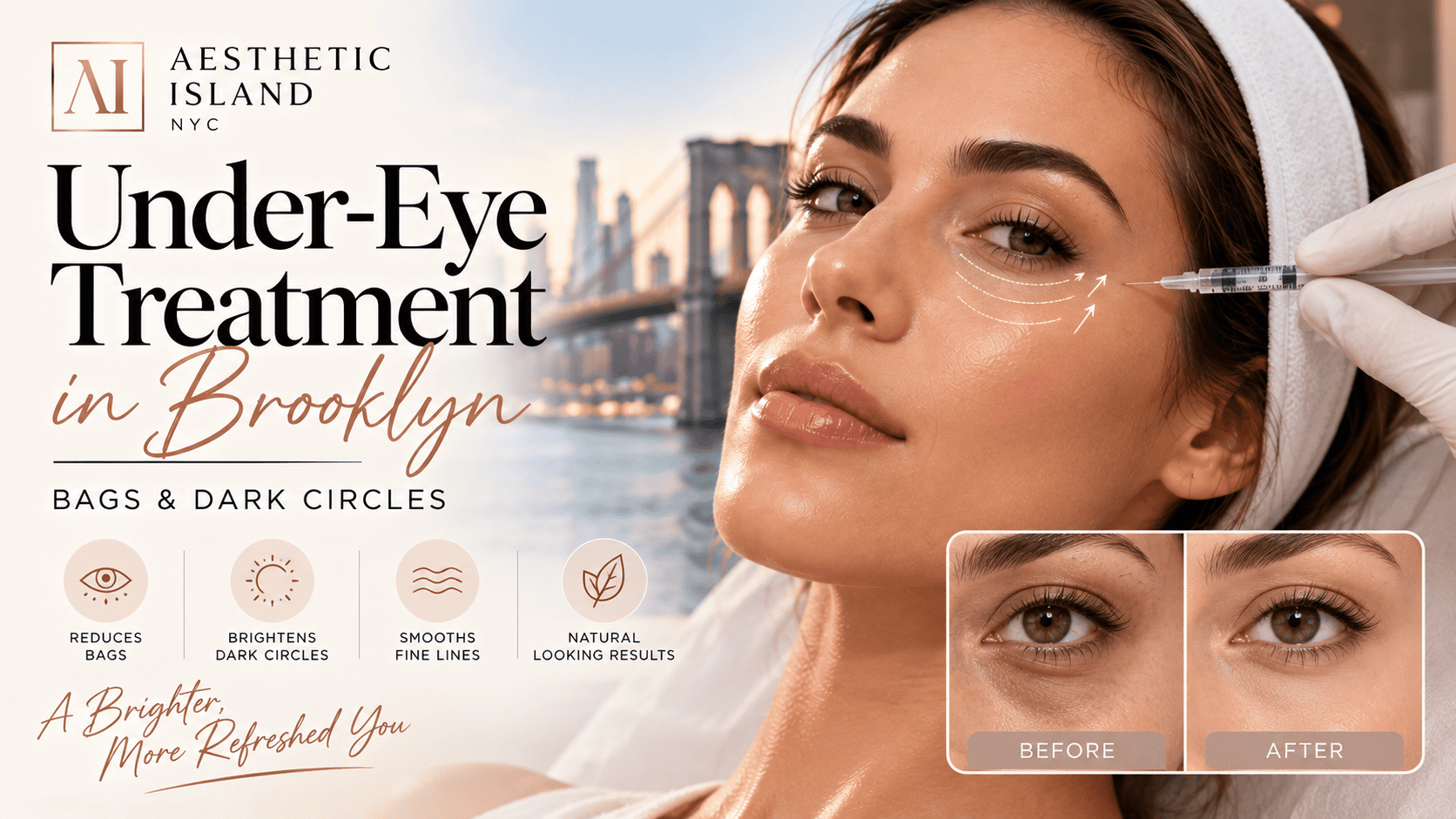
Few things make you look more tired than under-eye bags and dark circles — and few things are more frustrating, because no amount of concealer or sleep seems to fully fix them. If you’re searching for an effective under-eye treatment in Brooklyn, here’s the good news: you don’t need surgery to look refreshed again. A range of advanced non-surgical treatments can dramatically improve under-eye bags, dark circles, puffiness, and hollows — often with little to no downtime.
But here’s the key that most people miss: under-eye bags and dark circles aren’t all the same, and they don’t all respond to the same treatment. The right fix depends entirely on what’s actually causing your under-eye concern. In this guide, we’ll explain the different causes, walk through the best non-surgical under-eye treatments available in Brooklyn, and help you figure out which one is right for you. Let’s clear things up — literally.
Table of Contents
ToggleUnder-Eye Bags vs. Dark Circles: They’re Not the Same Thing
First, an important distinction. “Under-eye bags” and “dark circles” are often lumped together, but they’re different concerns with different causes — and treating them effectively means knowing which one (or combination) you’re dealing with.
Under-eye bags refer to puffiness, swelling, or a protruding appearance beneath the eyes. They’re about volume and texture — a physical fullness or sagging.
Dark circles refer to discoloration — the shadowy, bluish, brown, or purple tint under the eyes that makes you look tired even when you’re well rested. They’re about color and shadow.
Many people have both, and the two can feed into each other. Understanding the cause of yours is the first step toward the right under-eye treatment in Brooklyn.
What Causes Under-Eye Bags?
Under-eye bags can develop for several reasons, and often more than one is at play:
- Aging and fat displacement. As we age, the tissues and muscles supporting the eyelids weaken, and the fat that normally cushions the eye can shift forward and bulge, creating a “bag.” At the same time, skin loses collagen and becomes looser.
- Fluid retention and puffiness. Salt, alcohol, poor sleep, allergies, and even sleeping position can cause fluid to pool under the eyes, creating temporary puffiness.
- Genetics. Some people are simply predisposed to under-eye bags, often noticing them from a young age.
- Thinning skin. The skin under the eyes is the thinnest on the body, so changes there show up quickly and dramatically.
Because the causes vary, so do the solutions — which is exactly why a proper assessment matters.
What Causes Dark Circles? (The Three Types)
Here’s where it gets really important, because dark circles actually come in three main types, and each responds to completely different treatments. This is the single most useful thing to understand about treating dark circles.
1. Pigmented dark circles (brown). These are caused by excess melanin — essentially hyperpigmentation under the eyes. They often appear brown and are more common in medium-to-deeper skin tones. These respond best to treatments that target pigment.
2. Vascular dark circles (blue/purple). These are caused by blood vessels showing through thin under-eye skin, creating a bluish or purplish tint. They’re often worse with fatigue or poor circulation. These respond to treatments that improve skin quality and thickness or address the vascularity.
3. Structural dark circles (shadows). These aren’t really “color” at all — they’re shadows cast by a hollow or depression under the eye (the tear trough). As we lose volume with age, that hollow deepens, creating a dark, sunken look. These respond beautifully to volume restoration.
Many people have a combination of all three. Knowing your type is what separates an effective under-eye treatment in Brooklyn from a disappointing one. (For more clinical background on dark circles and under-eye concerns, the American Academy of Dermatology is a helpful resource.)
Why Choose Non-Surgical Under-Eye Treatment?
For years, the main fix for serious under-eye bags was surgery — specifically blepharoplasty (eyelid surgery). While surgery still has its place for significant cases, most people today prefer non-surgical options, and for good reason:
- No downtime (or very little), versus weeks of recovery from surgery
- Far lower cost than a surgical procedure
- Natural, adjustable results rather than a permanent surgical change
- Lower risk and no anesthesia
- The ability to address color and texture, not just remove fat
For mild-to-moderate under-eye bags, dark circles, and hollows, non-surgical treatments are often the ideal choice — delivering a refreshed, natural look without the knife. For significant excess skin or fat, an honest provider will tell you if surgery might be the better route.
The Best Non-Surgical Under-Eye Treatments in Brooklyn
Here are the most effective non-surgical treatments for under-eye bags and dark circles, and what each one does best.
Tear Trough Filler
For structural dark circles and hollows, dermal filler placed in the tear trough is often transformative. By restoring lost volume to the hollow under the eye, filler eliminates the shadow that creates a dark, sunken look — instantly brightening the area. It’s one of the most popular under-eye treatments for the right candidate.
- Best for: Structural dark circles (shadows), hollows, and mild bags caused by volume loss.
- Results: Immediate, typically lasting 9–18 months.
- Note: The under-eye is a delicate, high-risk area for filler, so provider skill is critical.
EZ Gel PRF (Natural Biofiller)
EZ Gel PRF is a standout for the under-eye area because it’s made entirely from your own blood — a 100% natural biofiller that restores subtle volume while releasing growth factors that improve skin quality and thickness over time. Because it’s natural and regenerative, it’s a favorite for patients who want a gentler, non-synthetic option in this delicate area. It’s especially good at improving the thin, crepey, discolored skin behind vascular dark circles. Learn more about rejuvenating your eyes with PRF.
- Best for: Vascular dark circles, thin/crepey under-eye skin, and patients wanting a natural option.
- Results: Build gradually; best with a short series. (See how long EZ Gel lasts.)
PRP Under the Eyes
Platelet-rich plasma (PRP), from the same regenerative family, uses your own platelets to stimulate collagen and improve the skin’s texture, thickness, and tone under the eyes. It’s an excellent choice for improving skin quality and reducing the appearance of dark circles caused by thin skin. See real PRP under-eye before and after results.
- Best for: Skin quality, fine lines, and vascular dark circles.
- Results: Gradual, natural improvement over a series.
Exosomes
Exosomes are a cutting-edge regenerative treatment that deliver powerful growth factors to rejuvenate and repair skin. Used under the eyes — often alongside microneedling or PRF — they help improve skin quality, texture, and tone for a fresher, brighter appearance.
- Best for: Overall under-eye skin quality and rejuvenation, often as a booster.
Microneedling & Morpheus8
Microneedling and Morpheus8 (radiofrequency microneedling) stimulate collagen to thicken and tighten the delicate under-eye skin, improving crepey texture and mild laxity. Thicker, firmer skin also helps camouflage vascular dark circles.
- Best for: Crepey texture, fine lines, mild laxity, and thin skin.
- Results: Build over a series as new collagen forms.
IPL Photofacial
For pigmented (brown) dark circles and surrounding sun damage, an IPL photofacial targets excess melanin and breaks up the pigment, brightening the area. (Our guide to IPL photofacials in Brooklyn covers it in detail.)
- Best for: Pigmented dark circles and sun damage around the eyes.
- Note: Best suited to certain skin tones; a consultation confirms candidacy.
Skin-Quality Boosters & Skincare
Finally, professional-grade skincare, hydrating injectable treatments, and good habits (sleep, hydration, sun protection, and a quality eye product) support and prolong the results of any under-eye treatment. These are the foundation that keeps the area looking its best.
Which Under-Eye Treatment Is Right for You?
Now for the part that ties it all together. Match your concern to the treatment:
| Your concern | Likely cause | Best treatments |
|---|---|---|
| Hollow, sunken look / shadows | Structural (volume loss) | Tear trough filler, EZ Gel PRF |
| Brown discoloration | Pigmented | IPL photofacial, skincare |
| Blue/purple tint | Vascular (thin skin) | PRF/EZ Gel, PRP, microneedling |
| Puffiness / bags | Fat or fluid | Skin tightening, lifestyle, (surgery if severe) |
| Crepey, thin, lined skin | Skin quality / collagen loss | Morpheus8, PRP, exosomes, EZ Gel |
As you can see, there’s no single “best” under-eye treatment — it depends entirely on your specific concern. And because most people have a combination of causes, the best results often come from combining treatments, which brings us to the next point.
The Power of Combination Treatments
Here’s what experienced providers know: the most dramatic, natural under-eye improvements usually come from addressing more than one cause at once. For example, tear trough filler or EZ Gel PRF to restore volume and eliminate shadows, plus PRP or microneedling to improve skin quality and thickness, plus IPL if there’s pigmentation — sequenced thoughtfully over time.
This layered approach treats the whole picture: volume, skin quality, and color together. It’s exactly why a professional consultation matters so much — a skilled provider diagnoses the real causes of your under-eye bags and dark circles and designs a combination plan tailored to you, rather than applying a one-size-fits-all fix.
What to Expect and Downtime
Most non-surgical under-eye treatments are quick and involve minimal downtime. Injectable treatments like filler and EZ Gel PRF take about 30 to 60 minutes, and you may have some mild swelling or bruising for a few days (the under-eye area can bruise easily). Microneedling and IPL have little downtime beyond temporary redness. Regenerative treatments like PRF, PRP, and exosomes build their results gradually over the following weeks and months.
Your provider will give you a personalized aftercare plan, but in general, you’ll be able to return to your normal routine quickly — one of the biggest advantages over surgery.
How Much Does Under-Eye Treatment Cost in Brooklyn?
Cost depends entirely on which treatment (or combination) you choose. As a general guide in the Brooklyn and NYC market, tear trough filler often runs around $800 to $1,500, regenerative treatments like EZ Gel PRF and PRP typically range from about $600 to $1,200 per session (often done as a series), and treatments like microneedling or IPL generally fall in the few-hundred-dollars-per-session range.
Because the right plan is personalized, the most accurate way to get your price is a consultation. And a quick but important note: the under-eye is one of the most delicate and higher-risk areas to treat, so this is absolutely not the place to shop for the cheapest injector. Provider skill directly affects both your results and your safety here.
What You Can Do at Home (to Support Your Results)
While professional treatments do the heavy lifting, a few habits genuinely help reduce under-eye bags and dark circles and extend your results between visits:
- Prioritize sleep. Poor sleep is one of the fastest ways to trigger puffiness and shadowing. Aim for consistent, quality rest.
- Sleep slightly elevated. Propping your head up a bit helps prevent fluid from pooling under the eyes overnight.
- Cut back on salt and alcohol. Both cause fluid retention that worsens puffiness — especially the night before.
- Protect against the sun. Daily SPF and sunglasses help prevent the pigmentation behind brown dark circles.
- Manage allergies. Chronic eye rubbing and allergy-related inflammation can darken and puff the area.
- Use a quality eye product. Ingredients like caffeine, vitamin C, peptides, and retinol can modestly improve the area over time — your provider can recommend the right one.
These habits won’t erase structural hollows or genetic bags on their own, but they make a real difference and protect the investment you make in professional treatment.
Who Is a Good Candidate?
Non-surgical under-eye treatment is a great option for most people bothered by bags, dark circles, puffiness, or hollows who want improvement without surgery. The best candidates have mild-to-moderate concerns and realistic expectations about natural-looking results.
For very severe under-eye bags with significant excess fat or skin, surgery (blepharoplasty) may ultimately deliver a better result — and an honest provider will tell you if that’s the case rather than selling you a treatment that won’t fully solve the problem. The only way to know for certain which treatment is right for you is a professional assessment.
Why Choose Aesthetic Island for Under-Eye Treatment in Brooklyn
The under-eye area is delicate, and results depend heavily on the provider’s skill and judgment. At Aesthetic Island in Brooklyn, your under-eye treatment is performed under the direction of our lead aesthetic provider, Eva Israilova, NP — in a practice featured in USA Today, OK! Magazine, Haute Living, and Haute Beauty.
We take the time to properly diagnose the actual cause of your under-eye bags and dark circles, then recommend the right treatment — or combination — for natural, refreshed results. With a full menu of options from tear trough filler to EZ Gel PRF, PRP, exosomes, microneedling, and IPL, we can treat every type of under-eye concern — and we’ll always be honest about what will (and won’t) work for you. To see how under-eye treatments fit into whole-face rejuvenation, explore our guide to a non-surgical facelift in Brooklyn.
Ready to finally look as rested as you feel? Book your under-eye consultation today or call (917) 809-0570.
Frequently Asked Questions
What is the best non-surgical treatment for under-eye bags and dark circles?
There’s no single best treatment — it depends on the cause. Hollows and shadows respond to tear trough filler or EZ Gel PRF; pigmented (brown) dark circles to IPL; vascular (blue) circles and thin skin to PRF, PRP, or microneedling. Many people benefit from a combination.
Can you fix dark circles without surgery?
Yes. Most dark circles can be significantly improved with non-surgical treatments like tear trough filler, EZ Gel PRF, PRP, microneedling, and IPL — the right choice depends on whether your dark circles are pigmented, vascular, or structural.
How much does under-eye treatment cost in Brooklyn?
It varies by treatment. Tear trough filler often runs about $800–$1,500, regenerative treatments like EZ Gel PRF and PRP about $600–$1,200 per session, and microneedling or IPL less per session. A consultation gives you an exact, personalized quote.
What causes dark circles under the eyes?
Three main things: excess pigment (brown), blood vessels showing through thin skin (blue/purple), and shadows from under-eye hollows (structural). Genetics, aging, fatigue, and sun exposure all contribute.
Is tear trough filler safe?
In the hands of a skilled, experienced provider, tear trough filler is very effective — but the under-eye is a delicate, higher-risk area, so it’s essential to choose a qualified injector. This is not a place to bargain-hunt.
How long do under-eye treatment results last?
It depends on the treatment: tear trough filler can last 9–18 months, while regenerative treatments like EZ Gel PRF and PRP build gradually and are maintained with periodic sessions. Your provider will recommend a maintenance plan.
Is there downtime after under-eye treatment?
Minimal. You may have mild swelling or bruising for a few days after injectables, or temporary redness after microneedling or IPL. Most people return to normal activities quickly.
Do under-eye creams actually work for bags and dark circles?
Quality eye products with ingredients like caffeine, vitamin C, peptides, and retinol can offer mild improvement and help maintain results, but they can’t fix structural hollows, displaced fat, or genetic bags. For meaningful change, professional treatments are far more effective.

