
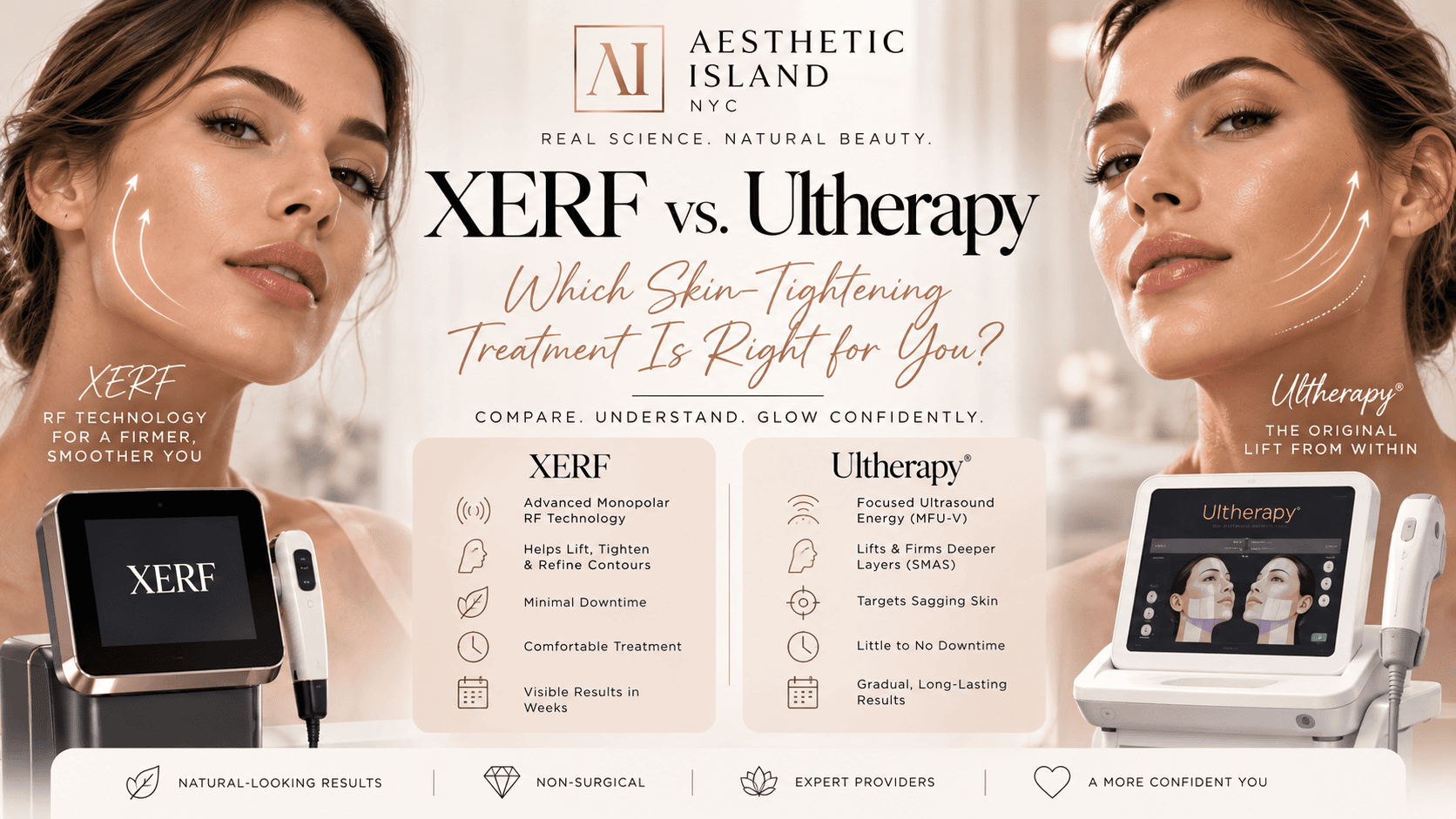
If you’ve been researching non-surgical skin tightening, two names keep coming up: XERF and Ultherapy. Both lift and firm sagging skin without surgery, both stimulate your own collagen, and both are done with zero to minimal downtime — so how do you choose? The XERF vs. Ultherapy question is one of the most common we hear from Brooklyn patients, and the honest answer is that neither is universally “better.” They’re different tools that excel at different things.
Because we offer both XERF and Ultherapy at our Brooklyn practice, we’re in a rare position to compare them honestly — without steering you toward the one device we happen to own. In this guide, we’ll break down how each treatment works, how they compare on comfort, results, downtime, and cost, which concerns each is best for, and how to decide which one is right for you. Let’s settle the XERF vs. Ultherapy debate.
Table of Contents
ToggleThe Quick Answer: XERF vs. Ultherapy at a Glance
If you want the short version before we dig in:
- Choose XERF if your priority is comfortable, overall tightening with no numbing needed, you like the idea of a newer radiofrequency technology, or you want a treatment that’s straightforward across all skin types.
- Choose Ultherapy if you want precise, deep lifting guided by real-time imaging, you’re targeting specific areas like the brow, jawline, or neck, or you value the longest clinical track record in non-surgical lifting. The newer Ultherapy PRIME platform also treats the body (arms and abdomen).
Both are excellent. The best choice depends on your concerns, your comfort preferences, and your provider’s assessment. Now let’s look at why.
What Is XERF?
XERF is a next-generation, non-invasive skin-tightening treatment made by Lutronic. It uses dual-frequency monopolar radiofrequency (RF) energy to heat the deeper layers of the skin, contracting existing collagen for an immediate firming effect and stimulating new collagen over the following weeks and months.
What makes XERF distinctive is that dual-frequency design — it delivers two RF frequencies (6.78 MHz and 2 MHz) to treat multiple depths in a single session, reaching both the dermis and the deeper structural layer. It’s also built for comfort, with integrated cooling that means most patients don’t need numbing cream. XERF received FDA clearance in the United States in 2025 after years of popularity in South Korea. To go deeper, see our complete guide to XERF.
What Is Ultherapy?
Ultherapy is the long-established gold standard in non-surgical lifting, made by Merz Aesthetics. Instead of radiofrequency, it uses micro-focused ultrasound (MFU) to deliver energy to the deep foundational layer of the skin — the same SMAS layer a surgeon tightens in a facelift — stimulating collagen to lift and tighten over time.
Ultherapy’s signature feature is real-time ultrasound imaging: it’s the only FDA-cleared treatment of its kind that lets the provider see beneath the skin during treatment and place energy precisely. It has one of the strongest bodies of clinical evidence in aesthetics, with millions of treatments performed. The newer Ultherapy PRIME platform improved comfort and speed and expanded treatment to the body.
XERF vs. Ultherapy: How They Work
The single biggest difference in the XERF vs. Ultherapy comparison comes down to the type of energy each one uses.
XERF uses radiofrequency (RF). RF energy heats the tissue to a target temperature, causing collagen fibers to contract immediately and triggering new collagen production over time. XERF’s dual-frequency approach lets it distribute that heat across multiple depths.
Ultherapy uses ultrasound. Micro-focused ultrasound creates tiny, precise points of thermal coagulation at specific depths — including the deep SMAS layer — which kick-starts the same collagen-building healing response, but through a different mechanism and with pinpoint depth control.
Here’s a helpful way to think about it: both treatments have the same goal (build collagen, tighten skin) but take different roads to get there. RF (XERF) heats broadly and comfortably across layers; ultrasound (Ultherapy) targets specific depths with imaging-guided precision. Neither approach is inherently superior — they simply have different strengths, which is exactly why the right choice depends on you. For a broader look at how both fit alongside other options, see our guide to a non-surgical facelift in Brooklyn. (For an overview of energy-based skin tightening in general, the American Academy of Dermatology is a helpful resource.)
XERF vs. Ultherapy: Side-by-Side Comparison
Here’s how the two treatments stack up across the factors that matter most:
| Factor | XERF | Ultherapy |
|---|---|---|
| Energy type | Dual-frequency monopolar RF | Micro-focused ultrasound |
| Real-time imaging | No | Yes (the only device with it) |
| Depth targeting | Multiple depths via dual frequency | Precise depths incl. deep SMAS |
| Comfort | High — cooling, usually no numbing | Original: moderate discomfort; PRIME: much improved |
| Downtime | None | None (mild redness/swelling possible) |
| Sessions | Often a short series | Often a single session |
| Results appear | Immediate tightening + build over weeks | Build over 2–3 months |
| Longevity | Builds; maintenance sustains | ~1 year or more |
| Best for | Comfortable overall tightening, all skin types | Precise deep lifting; PRIME adds body |
| Track record | New (FDA-cleared 2025) | Extensive, long-established |
| Approx. NYC cost | ~$1,200–$1,800/session | ~$1,500–$4,500 by area |
Figures are general Brooklyn/NYC estimates; your exact plan and cost are confirmed at consultation.
XERF vs. Ultherapy: Comfort
Comfort is one of the biggest practical differences between these two treatments, and historically it’s where XERF has an edge.
XERF was engineered around comfort. Its integrated cooling protects the skin’s surface while the RF energy heats the layers beneath, so most patients don’t need any numbing cream and describe the treatment as a warm, tolerable sensation. That also makes appointments faster, since there’s no wait for numbing to take effect.
Ultherapy, in its original form, developed a reputation for being uncomfortable — the energy delivery could be intense. However, this is exactly what the newer Ultherapy PRIME platform set out to fix, and it succeeded: clinical data shows PRIME delivers average pain scores less than half those of the original device. So if you’re comparing comfort, XERF has traditionally been the more comfortable option, but modern Ultherapy PRIME has narrowed the gap significantly. If comfort is a top priority for you, it’s worth asking your provider which Ultherapy platform they use.
XERF vs. Ultherapy: Results and Longevity
Both treatments deliver gradual, natural-looking results because both work by stimulating your own collagen — but the timelines differ slightly.
With XERF, many patients notice an immediate tightening effect right after treatment (from the RF contracting existing collagen), with fuller results building over the following weeks and months. XERF is often performed as a short series for optimal results.
With Ultherapy, results are more purely gradual, typically becoming most visible around two to three months after treatment as new collagen forms. Ultherapy is frequently done as a single session, and its results have been well documented to last a year or more.
In terms of longevity, both are durable because both build real collagen, and both benefit from occasional maintenance as your skin continues to age. Neither is permanent — no non-surgical treatment is — but both offer lasting improvement. If you want to understand XERF’s results more deeply, our post on whether XERF is worth it explores realistic expectations.
XERF vs. Ultherapy: Downtime
This is an easy one — both treatments are essentially downtime-free, which is a big part of their appeal.
After XERF, you may have brief redness or warmth that fades quickly, and you can return to normal activities and apply makeup the same day.
After Ultherapy, you may experience temporary redness, mild swelling, tenderness, or tingling, but these effects are typically mild and short-lived, and you can also return to your routine right away.
For anyone with a busy Brooklyn schedule, the lack of downtime with either treatment is a major advantage over surgery.
XERF vs. Ultherapy: Safety and Side Effects
Both XERF and Ultherapy have strong safety profiles when performed by a qualified, experienced provider, and both are FDA-cleared for skin tightening. Because they work with your body’s own collagen rather than introducing anything foreign into the skin, serious complications are rare.
Side effects for both are typically mild and temporary — think redness, slight swelling, tenderness, or tingling in the treated area that resolves within hours to a few days.
One meaningful safety point in the XERF vs. Ultherapy comparison: both are considered safe for all skin tones. Unlike some laser treatments that target pigment (and carry more risk on deeper skin), XERF’s radiofrequency and Ultherapy’s ultrasound both heat tissue regardless of skin color — making either a strong option across the full range of skin types.
As with any energy-based treatment, safety ultimately comes down to the skill of the provider. Proper assessment, correct settings, and precise delivery are what keep either treatment safe and effective — which is one more reason choosing an experienced provider matters even more than choosing the device.
XERF vs. Ultherapy: Cost
Cost is naturally a big factor in the XERF vs. Ultherapy decision, and the two are priced differently.
XERF is typically priced per session, often in the range of about $1,200 to $1,800, with many patients doing a short series. Ultherapy pricing varies more widely depending on how many areas you’re treating — a single small zone versus a full face and neck — and often ranges from around $1,500 to $4,500 or more, frequently as a single comprehensive session. Our detailed guide to Ultherapy cost in NYC breaks that down.
The most important cost advice: don’t choose based on the sticker price alone. Both are premium treatments, and the “cheaper” option isn’t a better value if it’s not the right treatment for your concern — or if it’s performed by an inexperienced provider. Focus on which treatment fits your goals, then find an experienced provider who offers it at a fair price.
Which Concerns Does Each Treatment Address Best?
Both XERF and Ultherapy tighten and lift, but their strengths lean in slightly different directions.
XERF tends to shine for:
- Comfortable, overall tightening of the face and neck
- Patients who want to avoid numbing and prefer a quick, warm treatment
- All skin types and tones
- Those drawn to the newest RF technology with immediate plus gradual results
Ultherapy tends to shine for:
- Precise, targeted lifting of specific areas — the brow, jawline, and neck
- Deep lifting where imaging-guided precision matters
- Patients who prefer a single-session approach with a long clinical track record
- Body tightening on the arms and abdomen (with the newer PRIME platform)
Because both are collagen-building tightening treatments, there’s real overlap — many patients would do well with either. That’s precisely why a professional assessment is the best way to match the treatment to your specific anatomy and goals.
Can You Combine XERF and Ultherapy?
A common question is whether you can do both. Generally, providers don’t perform XERF and Ultherapy on the same area at the same time — they’d be doing overlapping jobs. However, a comprehensive skin-tightening or non-surgical facelift plan might use one of them alongside other complementary treatments — like fillers for volume, Botox for dynamic lines, or Morpheus8 for texture — to address multiple layers of facial aging at once.
If you’re weighing energy treatments more broadly, you might also compare Ultherapy to RF microneedling — our post on Morpheus8 vs. Ultherapy covers that matchup. The key takeaway: the best results often come from a thoughtfully designed combination, not from any single device.
How to Choose Between XERF and Ultherapy
Still deciding? Here’s a simple framework:
Start with your primary concern. If you want precise lifting of a specific area like the brow or jawline, Ultherapy’s imaging-guided precision is compelling. If you want comfortable, overall tightening, XERF is a natural fit.
Consider your comfort preference. If a comfortable, no-numbing experience is a priority, XERF has traditionally led here — though Ultherapy PRIME has improved dramatically.
Think about your timeline and approach. Prefer a single comprehensive session? Ultherapy often fits. Comfortable with a short series and want some immediate effect? XERF may appeal.
Factor in skin type and goals. Both work across skin types, but your provider will tailor the recommendation to your specific skin and what you want to achieve.
Then talk to a provider who offers both. This is the most important step — and it’s where an honest, unbiased recommendation matters most.
Why It Matters Where You Go
Here’s something most XERF vs. Ultherapy comparisons won’t tell you: many practices only own one of these devices, which means their “recommendation” is really just the one machine they happen to have. That’s not necessarily bad, but it isn’t a truly objective comparison of what’s best for you.
At a practice that offers both XERF and Ultherapy, you get something more valuable: an honest assessment that considers your actual concerns and recommends whichever treatment — or combination — will genuinely serve you best. When a provider has no reason to push one device over the other, you can trust the recommendation.
XERF and Ultherapy at Aesthetic Island in Brooklyn
At Aesthetic Island in Brooklyn, we offer both XERF and Ultherapy, performed under the direction of our lead aesthetic provider, Eva Israilova, NP — in a practice featured in USA Today, OK! Magazine, Haute Living, and Haute Beauty. Because we have both technologies, we can give you a genuinely unbiased recommendation, matching the right treatment to your skin, your concerns, and your goals — never a one-size-fits-all pitch.
Whether XERF, Ultherapy, or a combination is right for you, we’ll help you decide with an honest, personalized consultation. Book your skin-tightening consultation today or call (917) 809-0570.
Frequently Asked Questions
Is XERF or Ultherapy better?
Neither is universally better — they use different energy (XERF uses radiofrequency, Ultherapy uses ultrasound) and excel at different things. XERF is known for comfort and overall tightening; Ultherapy for imaging-guided precise lifting and a long clinical track record. The best choice depends on your concerns and a provider’s assessment.
What’s the main difference between XERF and Ultherapy?
The core difference is the energy type: XERF uses dual-frequency radiofrequency, while Ultherapy uses micro-focused ultrasound with real-time imaging. This affects comfort, how the treatment is delivered, and the typical approach (XERF often a short series, Ultherapy often a single session).
Which is more comfortable, XERF or Ultherapy?
XERF has traditionally been more comfortable thanks to its cooling technology and no need for numbing. However, the newer Ultherapy PRIME platform is significantly more comfortable than the original, narrowing the gap.
Which lasts longer, XERF or Ultherapy?
Both build real collagen and offer durable, lasting results, with Ultherapy well documented to last a year or more and XERF results building and sustained with maintenance. Both benefit from occasional maintenance treatments.
How much do XERF and Ultherapy cost?
XERF is often around $1,200–$1,800 per session, while Ultherapy typically ranges from about $1,500 to $4,500 depending on the areas treated. Your exact cost is confirmed at consultation.
Can I get both XERF and Ultherapy?
They’re generally not performed on the same area together, but either can be part of a broader non-surgical facelift plan alongside complementary treatments like fillers, Botox, or Morpheus8. A consultation determines the best approach.
Are XERF and Ultherapy a replacement for a facelift?
No. Both are excellent for mild-to-moderate skin laxity, but neither removes significant excess skin the way surgery does. For advanced sagging, a surgical facelift may be more appropriate — an honest provider will tell you.

