
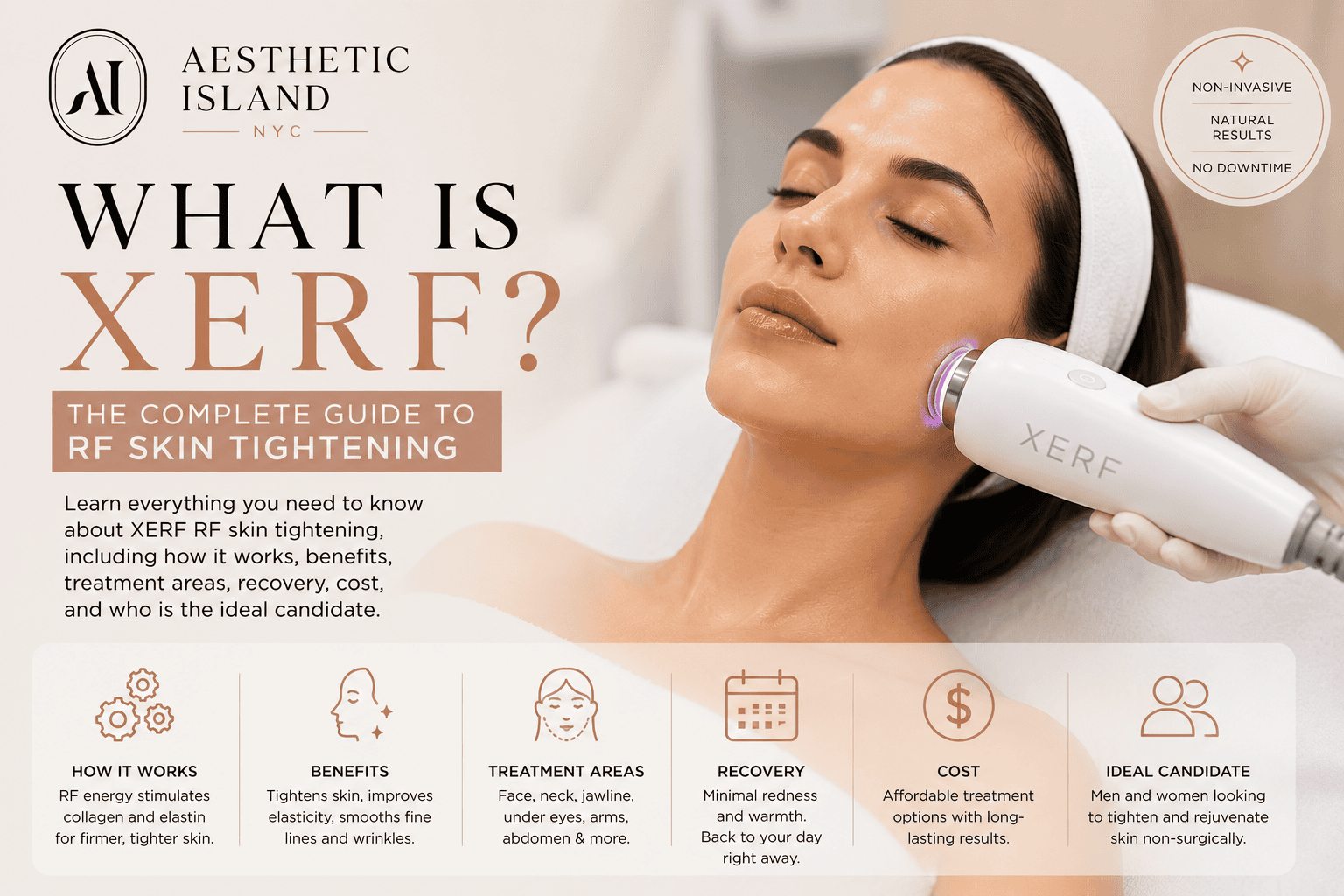
XERF is one of the most talked-about names in aesthetics right now — a skin-tightening treatment that seemed to appear everywhere at once, from beauty magazines to celebrity routines to your own social feed. But once you cut through the hype, a simple question remains: what actually is XERF, and does the technology live up to the buzz?
This is the complete guide. We’ll explain exactly what XERF is, the dual-frequency radiofrequency technology that sets it apart, how it works on your skin at a biological level, what it treats, how comfortable and safe it is, what results to expect, how it compares to other skin-tightening treatments, and what it costs. Whether you’re researching your first tightening treatment or comparing XERF against Ultherapy and Thermage, by the end you’ll understand this technology better than most.
Let’s start with the basics.
Table of Contents
ToggleWhat Is XERF?
XERF is a non-invasive, radiofrequency (RF) skin-tightening treatment developed by Lutronic, part of Cynosure Lutronic — a global leader in aesthetic and medical laser and energy devices. It uses controlled radiofrequency energy to heat the deeper layers of the skin, which tightens existing collagen immediately and stimulates the body to produce new collagen over time. The result is firmer, lifted, smoother-looking skin on the face, neck, and body — achieved without surgery, needles, injectables, or downtime.
XERF received FDA clearance in the United States in 2025, arriving in the American market after being widely and successfully used in South Korea, a country consistently at the forefront of non-invasive aesthetic innovation. That international track record is part of why XERF launched here with so much momentum: it wasn’t an unproven experiment, but a technology already trusted abroad.
In simple terms, XERF belongs to the family of energy-based skin-tightening treatments — the same broad category as Thermage and, in a different way, Ultherapy. What makes it stand out from that category is how it delivers its energy. That’s where the “dual-frequency” part comes in, and it’s the key to understanding XERF.
The Technology: What Makes XERF Different
To appreciate what’s genuinely new about XERF, it helps to understand the technology it builds on.
First, what is radiofrequency (RF) skin tightening?
Radiofrequency skin tightening has been used in aesthetics for years. It works by delivering RF energy into the skin, which generates heat in the deeper layers — specifically the dermis, where your collagen and elastin live. This controlled heating does two things: it causes existing collagen fibers to contract (an immediate tightening effect) and it triggers your body’s natural wound-healing response, prompting fibroblast cells to produce fresh collagen and elastin in the weeks and months that follow.
RF is popular because it’s effective, non-invasive, and — importantly — works on all skin tones. Unlike some laser treatments that target pigment (and therefore carry risk for darker skin), RF heats tissue regardless of color, making it a safe, inclusive option across skin types.
Monopolar RF: reaching the deep layers
Not all RF is the same. There are two main types: bipolar and monopolar. Bipolar RF passes energy between two closely spaced electrodes, which keeps the energy relatively shallow. Monopolar RF, on the other hand, delivers energy from a single electrode through the tissue, allowing it to penetrate much deeper.
XERF is a monopolar RF device, which is significant: deeper penetration means it can reach the structural layers of the skin responsible for the kind of lifting that superficial treatments can’t achieve. This is what allows XERF to target the deep support structures of the face — more on that shortly.
The innovation: dual-frequency monopolar RF
Here’s what truly separates XERF. Most monopolar RF devices operate at a single frequency, which limits how and where they deliver energy. Lutronic describes XERF as the first device to deliver dual-frequency monopolar RF — combining two distinct frequencies, 6.78 MHz and 2 MHz, in one system.
Why does that matter? Different RF frequencies interact with tissue at different depths. By combining two frequencies, XERF can deliver energy across multiple layers of the skin — both the superficial dermis and the deeper structural tissue — rather than being confined to a single depth. In practice, this gives the provider more control to place energy precisely where each patient needs it, treating multiple concerns and depths in a single session.
Lutronic calls this approach Structural Skin Tightening: the idea that by reaching and remodeling the deeper structural layers of the skin, XERF delivers tightening that’s stronger and longer-lasting than surface-level treatments. It’s the difference between smoothing the surface and firming the foundation underneath it.
How XERF Works on Your Skin
Let’s connect the technology to what’s actually happening beneath your skin during and after a treatment.
As we age, the collagen and elastin that keep skin firm and elastic break down, and our bodies produce less of them. The visible results are familiar: a softening jawline, a loosening neck, crepey texture, fine lines, and a general loss of the youthful “snap” skin once had. XERF addresses this decline directly, in two phases.
Phase one — immediate contraction. When XERF delivers RF energy into the dermis and the deeper subdermal layer, the heat causes the existing collagen fibers to contract and tighten right away. This produces a noticeable, if subtle, firming effect that many patients can see and feel soon after their treatment.
Phase two — collagen remodeling (neocollagenesis). The heat also creates a controlled thermal response that signals your body to begin repairing and rebuilding. Over the following weeks and months, fibroblasts produce fresh collagen and elastin, gradually improving the skin’s firmness, thickness, and texture. This is the phase that keeps working long after you’ve left the office, and it’s why XERF results build progressively rather than appearing all at once.
Crucially, because XERF’s monopolar dual-frequency design can reach the deeper SMAS/subdermal layer — the superficial musculoaponeurotic system, the same deep support structure a surgeon tightens during a facelift — its tightening addresses the foundation of facial support, not just the surface. That deep reach is what allows a non-invasive treatment to produce meaningful lift.
The Comfort Technology: Why XERF Feels Different
One of the most common complaints about older RF and energy treatments is discomfort — and often, the need for numbing cream before treatment. XERF was engineered specifically to solve this.
XERF integrates advanced cooling technology (Lutronic’s Advanced Integrated Cryogen Delivery) that continuously cools and protects the surface of your skin while the RF energy heats the layers beneath. By keeping the epidermis comfortable and safe, this system allows the device to deliver effective deep heating without the burning or stinging sensation older devices could cause.
The practical upshot is what Lutronic calls a Never-Numb experience: most patients don’t need topical numbing cream at all. That’s not just a comfort perk — it also means shorter appointment times, since there’s no 20-to-30-minute wait for numbing cream to take effect. Combined with its Wave Fit pulse technology, which controls how energy is delivered, XERF aims to make each session both effective and genuinely comfortable.
What Does XERF Treat?
Because XERF is customizable across frequencies, depths, and body areas, it’s a versatile treatment for early-to-moderate signs of aging and laxity. Patients commonly use XERF to:
- Lift and firm sagging skin on the cheeks, jawline, and jowls
- Tighten a loose or softening neck and the under-chin area
- Smooth fine lines, wrinkles, and crepey skin
- Restore definition to facial contours
- Firm crepey skin on the chest and décolleté
- Tighten body areas such as the abdomen, arms, and above the knees
Because it’s safe for all skin tones and involves no downtime, XERF is a treatment you can do year-round — including in summer, when some laser treatments aren’t recommended due to sun exposure.
Is XERF FDA-Approved and Safe?
XERF is FDA-cleared for non-invasive skin tightening in the United States (2025), which means it has met the FDA’s requirements for safety and effectiveness for its intended use. (A note on terminology: energy-based devices like XERF are “cleared” rather than “approved,” which is the standard regulatory pathway for this category — it’s a mark of validated safety, not a lesser status.)
In terms of safety, RF technology has a long, well-established record, and XERF’s cooling system is specifically designed to protect the skin’s surface during treatment. It’s considered safe for all skin types and tones. As with any medical aesthetic treatment, though, safety depends heavily on proper assessment and technique — which is why XERF should always be performed by a qualified, licensed medical professional after a genuine consultation to confirm you’re a good candidate.
What to Expect From an XERF Treatment
Here’s how the XERF process typically unfolds from start to finish.
The consultation. A qualified provider evaluates your skin, discusses your goals and concerns, confirms you’re a suitable candidate, and designs a treatment plan — including which areas to treat and how many sessions you’re likely to need.
The treatment. A session usually takes about 30 to 60 minutes, depending on the number and size of the areas being treated. Your provider glides the XERF device over the target areas as it delivers pulses of RF energy. You’ll feel a warming sensation throughout, moderated by the integrated cooling system. Thanks to that cooling, most patients are comfortable without any numbing.
Afterward. There’s no downtime. You may experience mild redness or a flushed, warm feeling for a short while, but this typically fades quickly. You can apply makeup and return to your normal activities immediately — no recovery period required.
Your treatment plan. While some tightening may be visible right away, many patients achieve the best results from a short series of sessions spaced out over time, followed by occasional maintenance treatments to sustain results as the skin continues to age.
XERF Results: What’s Realistic
Understanding what XERF can — and can’t — do is essential to being happy with your results.
Immediate effect. Because RF contracts existing collagen, many patients notice a subtle tightening soon after treatment.
Progressive improvement. The more significant results develop gradually, typically over about 8 to 12 weeks, as new collagen forms. This slow build is exactly why XERF results look natural rather than obviously “done” — you look progressively more refreshed, not suddenly different.
Longevity and maintenance. As new collagen matures, results can last a good while. But because your skin never stops aging and collagen continues to decline naturally, most patients maintain their results with periodic treatments. XERF is not a permanent, one-time fix — no non-invasive device is.
It’s not a facelift. This is the most important expectation to set. XERF firms, lifts, and smooths, and it can meaningfully improve mild-to-moderate laxity. It cannot remove significant excess skin or replicate the results of surgery for advanced sagging. For the right candidate, that’s exactly the appeal — real improvement without going under the knife. For someone with severe laxity, surgery may be the more appropriate option, and an honest provider will tell you so.
Individual results vary. Your age, skin condition, degree of laxity, treatment plan, and your body’s own collagen response all influence your outcome.
XERF vs. Other Skin-Tightening Treatments
If you’re researching XERF, you’re likely comparing it to the other big names. Here’s the short version:
- XERF (dual-frequency monopolar RF): Reaches multiple depths including the deep SMAS layer, comfort-forward with no numbing needed, natural progressive results. A strong all-rounder for mild-to-moderate laxity.
- Thermage (single-frequency monopolar RF): The long-established RF option — effective, but single-depth and often described as less comfortable.
- Ultherapy (micro-focused ultrasound): Uses ultrasound rather than RF to reach deep layers; effective, but many patients find it more uncomfortable, and it’s typically a single session with results over months.
- Morpheus8 (RF microneedling): Combines microneedling with RF, so it also improves skin texture and acne scarring — but it involves needles and some downtime, unlike XERF.
There’s no universal “best” treatment; the right choice depends on your skin, your goals, your comfort tolerance, and how much downtime you’re willing to accept. XERF’s strongest case is for someone who wants deep, comfortable tightening with zero downtime and no needles. (For a full breakdown, see our detailed XERF vs. Thermage vs. Ultherapy vs. Morpheus8 comparison.)
Who Is a Good Candidate for XERF?
XERF tends to be an excellent fit for people who:
- Have mild to moderate skin laxity they’d like to address, ideally early
- Are starting to notice a softening jawline, loosening neck, or crepey texture
- Want firming and prevention without surgery, needles, or downtime
- Prefer a comfortable treatment and would rather avoid numbing
- Have realistic expectations about gradual, natural-looking results
- Want a treatment that’s safe for their skin tone
The best way to know for certain whether XERF is right for you is a consultation with an experienced provider, who can assess your skin and confirm whether XERF — or a different treatment — will get you the results you want.
How Much Does XERF Cost?
XERF is a premium treatment, priced accordingly. In the NYC market, single sessions commonly range from roughly $1,200 to $1,800, depending on the areas treated, the provider’s expertise, and whether you choose a single session or a package. Because many patients benefit from a short series of treatments, it’s wise to think about the overall investment rather than the single-session price alone. Many practices, including ours, also offer financing options to make a treatment plan more manageable.
The Bottom Line
So, what is XERF? It’s a next-generation, non-invasive skin-tightening treatment that uses dual-frequency monopolar radiofrequency to heat and remodel the deep structural layers of your skin — tightening existing collagen immediately and building new collagen over time, all without surgery, needles, or downtime. Its combination of deep reach, comfort-focused cooling, and natural, progressive results is what’s earned it so much attention, and for the right candidate, the technology genuinely delivers.
Like any treatment, it works best when it’s matched to the right person with realistic expectations and performed by a skilled, licensed provider. If you’re curious whether XERF is right for your skin and goals, the next step is simple: a consultation.
Experience XERF in Brooklyn
At Aesthetic Island in Brooklyn, XERF is performed by our lead aesthetic provider, Eva Israilova, NP, in a practice featured in USA Today, OK! Magazine, Haute Living, and Haute Beauty. As one of the first practices in Brooklyn to offer XERF, we’ll help you understand exactly what it can do for your skin — honestly and with no pressure — and design a plan around natural, lasting results. Book your XERF consultation today, or call us at (917) 809-0570..
Frequently Asked Questions
What is XERF used for?
XERF is used for non-invasive skin tightening and facial rejuvenation — firming sagging skin, smoothing wrinkles and crepey texture, and improving contour on the face, neck, and body.
What does “dual-frequency” mean in XERF?
It means XERF delivers two RF frequencies (6.78 MHz and 2 MHz), allowing it to treat multiple depths of the skin in a single session rather than being limited to one depth like most RF devices.
Is XERF the same as Thermage?
Both are monopolar RF treatments, but XERF is dual-frequency and built around comfort (no numbing needed), while Thermage is a single-frequency device. They’re related but not identical.
Does XERF hurt?
Most patients find XERF comfortable. Its integrated cooling protects the skin’s surface, so numbing cream usually isn’t needed — you’ll feel a warming sensation during treatment.
Is XERF FDA-approved?
XERF is FDA-cleared for non-invasive skin tightening in the U.S. as of 2025, following extensive use internationally.
How long do XERF results last?
Results build over 8 to 12 weeks as new collagen forms and can be long-lasting, though periodic maintenance is typically recommended since skin continues to age.
Is XERF safe for all skin types?
Yes — because RF heats tissue regardless of pigment, XERF is designed to be safe for all skin tones and types.
Book your XERF consultation today, or call us at (917) 809-0570.

